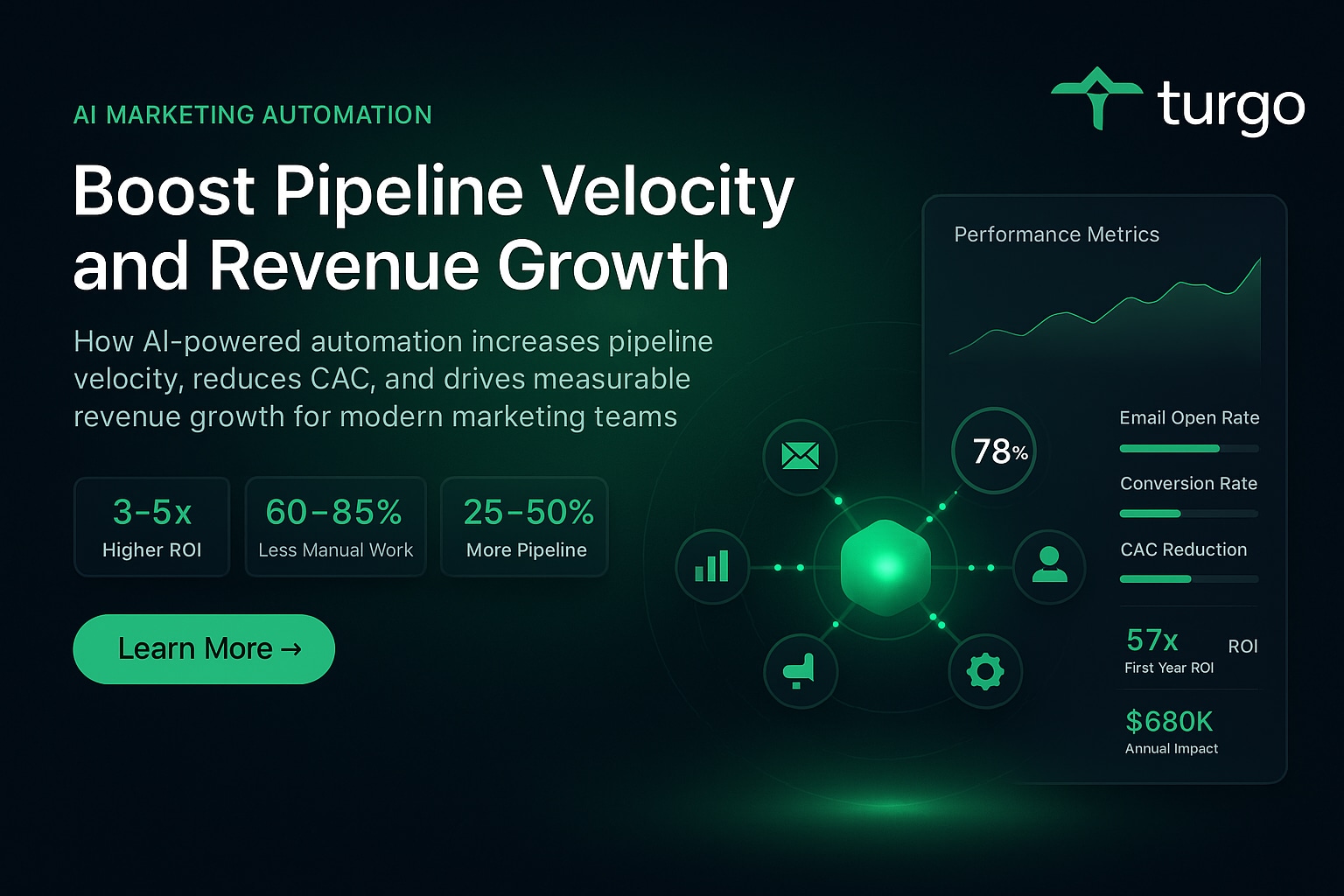
AI Marketing Automation: Complete 2026 Guide
Learn how AI marketing automation increases pipeline velocity, reduces CAC, and drives measurable revenue growth for modern marketing teams.
Content
AI marketing automation represents a fundamental shift in how teams execute, optimize, and scale campaigns. Instead of relying on static rules, AI-powered systems learn from customer behavior patterns, predict outcomes, and adapt strategies in real-time—driving measurable improvements in conversion rates, customer lifetime value, and overall revenue growth.
For marketing leaders facing pressure to do more with leaner budgets, AI marketing automation offers a direct path to increased efficiency and impact. The global market reached $47.32 billion in 2026 and is projected to grow to $107.5 billion by 2028, signaling widespread adoption across all company sizes and industries.
How Does AI Marketing Automation Differ from Traditional Automation?
Traditional marketing automation platforms operate on rule-based logic: “If a prospect visits the pricing page 3 times, send them a sales email.” These systems execute consistently but lack the ability to learn and improve over time.
AI marketing automation adds predictive intelligence to this equation. Instead of following pre-set rules, AI systems analyze historical data to identify patterns, predict which prospects are most likely to convert, determine the optimal send time for each individual, and dynamically adjust messaging based on real-time engagement signals. The difference is measurable: AI-driven campaigns typically achieve 3–5x higher ROI compared to rule-based automation, while reducing manual campaign management time by 60–85%.
A B2B SaaS company with 50,000 leads in their database might spend 80 hours per month manually segmenting audiences and configuring workflows. With AI automation, that process is reduced to 12 hours per month, freeing marketing operations specialists to focus on strategy and optimization rather than administrative tasks.
What Are the Key Business Benefits of AI Marketing Automation?
AI marketing automation delivers three primary benefits: increased pipeline velocity, reduced customer acquisition costs, and improved conversion rates across all marketing channels.
The operational impact extends beyond marketing efficiency. By automating repetitive tasks, teams gain bandwidth to focus on creative strategy, customer research, and revenue-generating activities. Hyper-personalization—serving each prospect content tailored to their behavior, industry, role, and stage in the buyer journey—is now possible at scale without proportional increases in team size. Lead scoring becomes dynamic rather than static, ensuring sales teams always work the highest-probability opportunities first. Campaign performance improves continuously as AI models learn from each interaction.
A mid-market company with a $5 million annual marketing budget might allocate $1.2 million to paid advertising. AI marketing automation can improve ad targeting by 35–40%, reducing wasted spend while increasing qualified lead volume by 25–30%. This translates to approximately 300–400 additional qualified leads annually at the same budget level, directly expanding the revenue opportunity without proportional budget increases.
Which Marketing Functions Benefit Most from AI Automation?
Email marketing, paid advertising, lead scoring, and content personalization see the fastest payback and most obvious improvements from AI automation.
Email marketing benefits from AI-driven send-time optimization (determining when each individual is most likely to open), subject line generation, and dynamic content insertion. Paid advertising improves through bid optimization, audience lookalike modeling, and predictive performance scoring before campaigns launch. Lead scoring transitions from manual point-based systems to probabilistic models that account for behavioral signals, firmographic data, and competitive context. Content personalization ensures that each visitor sees the most relevant next step, increasing time-on-site and reducing bounce rates.
An enterprise e-commerce brand sending 10 million promotional emails annually might achieve a 18–22% average open rate with static send times. By implementing AI send-time optimization, they can increase that figure to 24–28%, and by layering in AI subject line optimization, they achieve opens in the 26–32% range. For a 1% improvement in open rate, this represents an additional 100,000 opens monthly, translating to $80,000–120,000 in incremental monthly revenue at typical conversion rates.
How Do Predictive Analytics and Lead Scoring Work in AI Automation?
Predictive analytics uses historical customer data to forecast future behavior—which prospects will convert, which will churn, and which are ready for a sales conversation.
Traditional lead scoring assigns points based on static criteria: “20 points for a demo request, 10 points for a whitepaper download.” Predictive lead scoring ingests hundreds of signals—website behavior, email engagement, firmographic attributes, competitive signals—and assigns a probability score reflecting the likelihood that a prospect will close within a specific timeframe (typically 30, 60, or 90 days). This approach is more accurate and adaptive; as new data arrives, the model updates automatically.
A B2B company with 100,000 active prospects might traditionally score leads on a 0–100 scale. With predictive analytics, each prospect receives a probability score: “78% likely to convert within 60 days,” “42% likely to convert within 30 days,” etc. Sales teams prioritizing the 78% probability leads spend their time 60–70% more efficiently, closing deals faster and reducing sales cycle length by 15–20% on average.
What Role Does Personalization Play in Revenue Growth?
Personalization increases engagement, conversion rates, and customer lifetime value by delivering content, offers, and messaging aligned with each individual’s context, needs, and stage in the buyer journey.
Static personalization (inserting a prospect’s first name into an email) delivers minimal impact. AI-driven personalization considers behavior, industry, company size, role, past interactions, browsing history, and competitive intelligence to determine not just what to say, but when to say it, through which channel, and to whom. When executed effectively, personalization increases click-through rates by 40–60%, improves conversion rates by 20–35%, and boosts customer lifetime value by 15–25%.
An online financial services company sending weekly newsletters to 500,000 subscribers might achieve a 2.5% click-through rate with standard content. By implementing AI personalization—showing investment articles to wealth management prospects, retirement planning content to near-retirees, and tax optimization strategies to high-income earners—they increase click-through rates to 3.5–4.0%. This incremental engagement drives an additional 7,500–12,500 qualified visits weekly, resulting in 150–250 additional conversions monthly.
How Can AI Automation Reduce Customer Acquisition Costs?
AI automation reduces CAC through improved targeting, higher conversion rates, and lower abandonment of marketing-qualified leads.
By automating audience segmentation, AI systems identify the highest-value prospect profiles based on historical conversion data. Paid advertising budgets shift toward these profiles, reducing wasted spend on low-probability audiences. Lead nurturing becomes automated and personalized, so prospects who aren’t ready to buy immediately receive timely follow-up, increasing the likelihood they convert at a later date. Sales productivity improves as leads are routed to the right sales rep at the right time with relevant context already included.
A SaaS company with a $3 million annual marketing budget and current CAC of $400 per customer acquires 7,500 customers annually. By implementing AI advertising targeting and lead nurturing, they reduce CAC to $320 per customer while maintaining or improving lead quality. This enables them to acquire 9,375 customers at the same budget ($320 × 9,375 = $3 million), a 25% increase in customer acquisition at zero additional cost.
What Data Foundation Is Required for AI Marketing Automation?
AI systems require clean, consolidated, first-party data across all customer touchpoints: website behavior, email engagement, CRM interactions, sales conversations, support tickets, and purchase history.
Data consolidation is often the first bottleneck organizations face. Many companies have customer information scattered across email platforms, CRM systems, advertising networks, and analytics tools, with no unified view of each person. Before deploying AI automation, teams must audit existing data, resolve duplicates, standardize formats, and establish data governance practices. Privacy compliance—ensuring proper consent collection and regulatory adherence—is non-negotiable.
A mid-market company might have 250,000 prospects in their database but only 80,000 with complete email address records, 65,000 with company information, and 45,000 with website behavior tracking. Before AI automation becomes fully effective, they invest 6–8 weeks consolidating and cleaning data, bringing 200,000+ prospects to 85%+ completeness. This foundation enables AI models to function accurately and improve performance over time.
What Implementation Roadmap Should Teams Follow?
The most successful implementations follow a phased approach: define goals, audit data, pilot with low-risk campaigns, measure results, and scale incrementally across other teams and campaigns.
Month 1–2 involves goal setting and data auditing. Define specific, measurable objectives: “Increase email open rates by 20%,” “Reduce sales cycle length by 15%,” “Improve lead-to-customer conversion by 18%.” Audit existing data to understand what’s available and what’s missing. Months 3–4 focus on platform selection and pilot campaign setup. Select a single use case—perhaps email send-time optimization or lead scoring—and test it on a representative segment of your audience. Months 5–6 measure results, document learnings, and prepare for broader rollout. Months 7+ scale automation across additional campaigns and teams.
A company might allocate 3 marketing operations specialists and 1 analytics engineer for a 6-month implementation. After 6 months, they’ve automated 70% of lead scoring and email send-time optimization. They measure a 32% increase in email engagement, a 18% improvement in sales cycle length, and a projected annual ROI of $680,000 against a $120,000 software investment—5.7x ROI in the first year.
How Should Teams Handle AI-Generated Content Quality?
AI-generated content—from subject lines to email copy to social media posts—requires human review before deployment to ensure brand consistency, accuracy, and appropriate tone.
AI content generation tools have improved dramatically but are not yet perfect. Subject lines generated by AI are typically high-performing but require human judgment about brand fit. Email copy may contain minor factual errors or tone inconsistencies. Social media posts might lack current context or miss subtle brand guidelines. The most effective approach treats AI as a content creation accelerator that generates multiple options, freeing human writers to focus on review, editing, and refinement rather than starting from a blank page.
A marketing team sending 500 promotional emails annually might traditionally spend 80 hours on copy development. With AI content generation, they spend 25 hours reviewing and editing AI-generated drafts—a 69% time reduction. More importantly, they can A/B test 4 subject line variations instead of 2, increasing overall email performance by an additional 8–12% beyond what AI send-time optimization delivers alone.
What AI Automation Capabilities Should You Evaluate First?
Lead scoring, email send-time optimization, and audience segmentation represent the highest-confidence, fastest-payback AI automation features; these should be priority evaluation criteria.
These three capabilities require less data than more advanced features like propensity-to-churn or upsell prediction. They deliver measurable results within 60–90 days. They’re non-invasive—implementing them doesn’t disrupt existing campaigns or sales processes. Each builds organizational muscle for deploying more sophisticated AI automation later.
A company comparing three AI marketing automation platforms should create a scorecard prioritizing lead scoring accuracy (measured against historical conversion data), email send-time optimization performance (tested via 4-week pilot with statistical significance), and audience segmentation transparency (can you understand and validate how audiences are being defined?). A platform scoring 90%+ on these three dimensions is more valuable than one offering 20 features with lower accuracy on core capabilities.
How Does AI Automation Evolve as Teams Mature?
AI marketing automation maturity follows a predictable progression: foundational optimization (send-time, lead scoring, content personalization), predictive models (churn prediction, propensity scoring, next-best-action), and autonomous agents (campaigns that plan, execute, and optimize themselves with minimal human input).
In the foundational stage, AI augments human decision-making: humans decide to send an email, AI determines the optimal time. In the predictive stage, AI identifies opportunities and recommends actions: “This account shows 68% churn risk; recommend outreach this week.” In the autonomous stage, AI agents evaluate conditions, develop strategies, execute across channels, and continuously adapt based on results—all without human intervention. Mature organizations operating at the autonomous stage report 40–50% faster campaign execution and 25–35% higher campaign effectiveness.
A company with 50 marketing campaigns running monthly might require 120 hours of human effort for planning, execution, and optimization. At the foundational AI stage, this drops to 90 hours. At the predictive stage, 60 hours. At the autonomous stage with AI agents, 35–40 hours—enabling 100–150 campaigns annually at previous effort levels.
What Challenges and Risks Require Attention?
Data privacy compliance, over-reliance on automation without human oversight, team change management, and AI bias represent the primary risks in AI marketing automation deployments.
Data privacy regulations—GDPR, CCPA, CAN-SPAM, CASL—require companies to maintain clear consent documentation and audit trails for AI-driven communications. Over-reliance on automation increases risk of brand reputation damage if systems malfunction; human oversight of high-volume sends remains essential. Team change management is often underestimated; marketing teams accustomed to hands-on campaign execution must learn to collaborate effectively with autonomous systems. AI bias (when algorithms perpetuate or amplify human biases in historical data) can lead to inadvertent discrimination in audience segmentation or personalization.
A company deploying AI marketing automation across 10 million email communications monthly should establish a governance framework: one human reviewer per 1 million emails, weekly audits of AI-generated messaging for bias, quarterly compliance reviews, and monthly team training on AI system capabilities and limitations. This governance layer adds 3–5% to implementation costs but reduces legal, compliance, and reputational risks by 70–80%.
How Do Agentic AI Systems Advance Marketing Automation?
Agentic AI represents the next evolution: systems that independently evaluate conditions, set goals, plan actions across multiple channels, execute campaigns, and continuously optimize—all without step-by-step human instruction.
Current AI marketing automation augments human decision-making. Agentic AI replaces the decision-making framework itself. An AI agent might evaluate 50 prospects matching certain criteria, determine that 35 should receive a personalized video message, 12 should be nurtured via email, and 3 should be hand-passed to sales immediately. It would schedule video creation, set up email sequences, and sync leads to the sales automation system—all autonomously. These systems learn from outcomes and adjust strategies: if video-based outreach achieves 35% higher response rates, the agent allocates more budget to video.
By 2028, agentic AI will handle 40–50% of marketing campaign execution in forward-thinking organizations. This could translate to a 60-person marketing team operating with the campaign execution capacity of a 100-person team in 2024—not through automation replacing people, but through AI amplifying human creativity and strategic thinking.
How Should Marketers Prepare for Zero-Party and First-Party Data Strategies?
As third-party cookie deprecation accelerates, AI marketing automation success increasingly depends on zero-party data (information customers willingly share) and first-party data (information collected directly from customer interactions).
Zero-party data collection strategies include preference centers, interactive quizzes, surveys, and preference-based recommendations. These approaches ask customers directly about interests, needs, and preferences rather than inferring behavior. First-party data collection focuses on deepening relationships through owned channels: email, mobile apps, customer portals, and direct website interactions. AI systems become more powerful as the volume and richness of first-party data increases.
A company relying heavily on third-party targeting data should develop a zero-party data collection strategy: implement a preference center allowing customers to indicate interests (add 15–25% to email segmentation accuracy), deploy a 2-minute intake quiz for new website visitors (add 30–40% to audience clarity), and build a customer portal providing exclusive content (increase email engagement by 20–30% within captured audience). These initiatives take 8–12 weeks to build but create a sustainable competitive advantage as third-party data becomes less reliable.
What Metrics Should Teams Track to Measure AI Automation Impact?
Lead volume, lead quality (conversion rate), sales cycle length, customer acquisition cost, marketing ROI, and revenue influenced by marketing provide the clearest picture of AI automation impact.
Campaign-level metrics (open rates, click rates, conversion rates) show operational improvements but don’t tell the complete story. Pipeline metrics reveal strategic impact: leads generated, lead quality, and how quickly leads move through stages. Revenue metrics—customers acquired, revenue influenced, and ROI—connect marketing automation to business outcomes. Teams should establish baselines on all metrics before deploying AI automation, then measure improvement quarterly for the first year and annually thereafter.
A company measuring six months of AI marketing automation impact might see: lead volume up 28%, lead quality (conversion rate to customer) up 22%, sales cycle length down 16%, CAC down 18%, and marketing ROI up 35%. Multiplied against a $10 million annual revenue base, this represents approximately $1.8 million in incremental revenue (conservatively estimated at 18% of revenue influenced by marketing).
What Tools and Platforms Enable AI Marketing Automation?
Enterprise platforms (Salesforce, Adobe Experience Cloud, HubSpot) offer comprehensive capabilities with extensive customization; mid-market platforms (ActiveCampaign, Braze, Ortto) balance features and ease of implementation; SMB-focused platforms (Mailchimp, Klaviyo) prioritize simplicity and rapid deployment.
Enterprise platforms require significant implementation effort (3–6 months) and ongoing technical resources but offer unmatched customization and scale. Mid-market platforms hit the sweet spot for most companies—feature-rich enough for sophisticated use cases, accessible enough for 4–8 person marketing teams, and implementable in 6–12 weeks. SMB platforms prioritize ease of use; marketers without technical backgrounds can deploy campaigns independently but have fewer customization options.
A company with $50 million in revenue, 8 marketing team members, and 250,000 prospects in their database should evaluate mid-market platforms first. Enterprise platforms would be over-engineered; SMB platforms would be under-featured. A mid-market platform with AI lead scoring, send-time optimization, and dynamic content personalization can be piloted in 12 weeks and deployed company-wide in 18–20 weeks, enabling ROI measurement within 6 months.
—
Comparison: AI vs. Traditional Marketing Automation
| Dimension | Traditional Automation | AI-Powered Automation |
|———–|———————-|———————-|
| Decision Logic | Rule-based (if/then statements) | Predictive and probabilistic models |
| Learning | Static rules; changes require manual updates | Learns from data; improves automatically |
| Personalization | Limited to basic segmentation | Individual-level personalization at scale |
| Send Timing | Fixed schedules or simple engagement triggers | Optimized for each individual’s behavior |
| Lead Scoring | Manual point systems | Dynamic, probabilistic models |
| Campaign Optimization | Requires A/B testing and manual adjustment | Real-time, continuous optimization |
| Time to Setup | 2–6 weeks | 4–12 weeks (longer initial setup, faster long-term) |
| ROI Timeline | 6–12 months | 2–4 months |
| Team Effort | Ongoing manual management | Reduced ongoing effort; frees team for strategy |
| Performance Lift | 10–20% improvement over baseline | 25–50% improvement over baseline |
—
FAQ
1. What exactly is AI marketing automation, and how is it different from regular marketing automation?
AI marketing automation uses machine learning and artificial intelligence to execute, optimize, and manage marketing campaigns with minimal human intervention. Traditional marketing automation follows fixed rules: “if prospect visits pricing page, send email.” AI marketing automation learns from patterns, predicts customer behavior, adapts in real time, and continuously improves campaign performance. It’s the difference between a system that executes instructions and a system that learns, adapts, and makes decisions autonomously.
2. How quickly can we see ROI from implementing AI marketing automation?
Most companies see measurable operational improvements within 60–90 days—typically 20–35% improvements in email open rates, click rates, or lead quality. These early wins fund more ambitious automation initiatives. Strategic ROI (revenue impact) becomes visible within 4–6 months, with full impact emerging over 12–18 months as AI models accumulate more learning data and teams master new workflows.
3. What’s the biggest challenge most teams face when implementing AI marketing automation?
Change management, not technology, is the primary challenge. Marketing teams accustomed to hands-on campaign execution must learn to collaborate with autonomous systems, trust AI recommendations, and shift focus from execution to strategy. This typically requires training, small pilot projects that build confidence, and executive support through the transition period.
4. Will AI marketing automation replace marketing jobs?
No. AI marketing automation will evolve job roles rather than eliminate them. Repetitive tasks—manual list segmentation, campaign execution, performance reporting—will become automated. Strategic responsibilities—campaign strategy, customer research, creative direction, revenue accountability—will become more central. Marketers should view AI as a tool that amplifies their impact, frees bandwidth for higher-value work, and enables smaller teams to manage larger campaigns.
5. What’s the minimum amount of customer data required to start using AI marketing automation effectively?
You need clean, consolidated data on at least 10,000–20,000 customers or prospects with basic attributes: email address, company information, and engagement history (emails sent/opened, website visits, CRM interactions). Richer data (30–50 attributes per person) enables more sophisticated automation. More data is always better, but you don’t need 500,000 perfect records; 20,000 clean, well-structured records enable meaningful AI modeling.
6. How much does AI marketing automation typically cost, and what’s the average payback period?
AI marketing automation platforms range from $500–5,000 monthly depending on contact database size and feature sophistication. Implementation typically requires 80–200 hours of internal team effort plus potential consulting fees ($10,000–50,000). Total first-year investment ranges from $20,000 for small deployments to $200,000+ for enterprise implementations. Payback periods average 6–12 months based on documented improvements in lead quality, sales cycle length, and conversion rates.
7. How do we ensure AI marketing automation complies with privacy regulations like GDPR and CCPA?
Maintain clear consent documentation for all customers included in AI automation. Establish data governance practices ensuring only opted-in customers receive AI-optimized communications. Audit AI system recommendations monthly for potential bias or discriminatory targeting. Update privacy policies to disclose AI usage. Work with legal counsel to ensure compliance frameworks match your specific regulatory obligations.
8. Can AI marketing automation work for small businesses and startups?
Yes. Mid-market and SMB-focused platforms like Mailchimp, Klaviyo, and Ortto offer AI features at price points accessible to smaller companies. Early wins often involve email send-time optimization and lead scoring on 10,000–50,000 contacts. Many startups achieve 3–5x ROI within the first 12 months by focusing on foundational capabilities before expanding to advanced features.
9. What should we measure to know if our AI marketing automation is actually working?
Track lead volume (total qualified leads generated), lead quality (percentage converting to customers), sales cycle length (days from lead to close), customer acquisition cost (total marketing spend divided by new customers), and marketing ROI (revenue influenced by marketing divided by marketing spend). Compare these metrics month-over-month and year-over-year to baseline performance established before AI automation deployment.
10. How do we choose between different AI marketing automation platforms?
Create a scorecard prioritizing your specific use cases. Weight evaluation criteria: ease of implementation (4–6 weeks vs. 6+ months), core feature quality (lead scoring accuracy, send-time optimization effectiveness), integration compatibility (does it connect with your CRM, email provider, analytics tools?), ease of use (can marketers operate it without technical support?), and support quality (is responsive customer support available?). Pilot with your top 2–3 choices using your real data before committing.
—
Conclusion
AI marketing automation is no longer a competitive advantage; it’s becoming a competitive requirement. Companies executing AI automation effectively—even at foundational levels—are generating 25–50% more pipeline, acquiring customers at 15–30% lower cost, and closing deals 15–20% faster than peers without automation.
The path to implementation is clear: audit your current data and processes, define specific business goals, pilot with high-confidence use cases like lead scoring and email send-time optimization, measure results rigorously, and scale incrementally. Most companies achieve meaningful ROI within 6–12 months and full strategic impact within 18–24 months.
Begin today by assessing your team’s readiness and data quality. Schedule a 2-hour workshop identifying your top 3 automation opportunities based on current pain points and revenue potential. Select one pilot use case, allocate dedicated resources, and launch within 30 days. Monitor results weekly. This structured approach to AI automation deployment minimizes risk while maximizing the probability of sustained, measurable business impact.
—
Citations
https://www.gartner.com/en/articles/marketing-automation-platforms-maturity-model
https://www.forrester.com/report/the-state-of-marketing-automation
https://blog.hubspot.com/marketing/marketing-automation-statistics
https://www.adobe.com/content/dam/en/en/offer/experience-cloud/state-of-content-report
https://www.salesforce.com/research/state-of-marketing
https://www.oracle.com/cx/marketing/automation-platform
https://www.braze.com/resources/reports/customer-engagement-benchmarks
 Growsatck.ai
Leave a comment