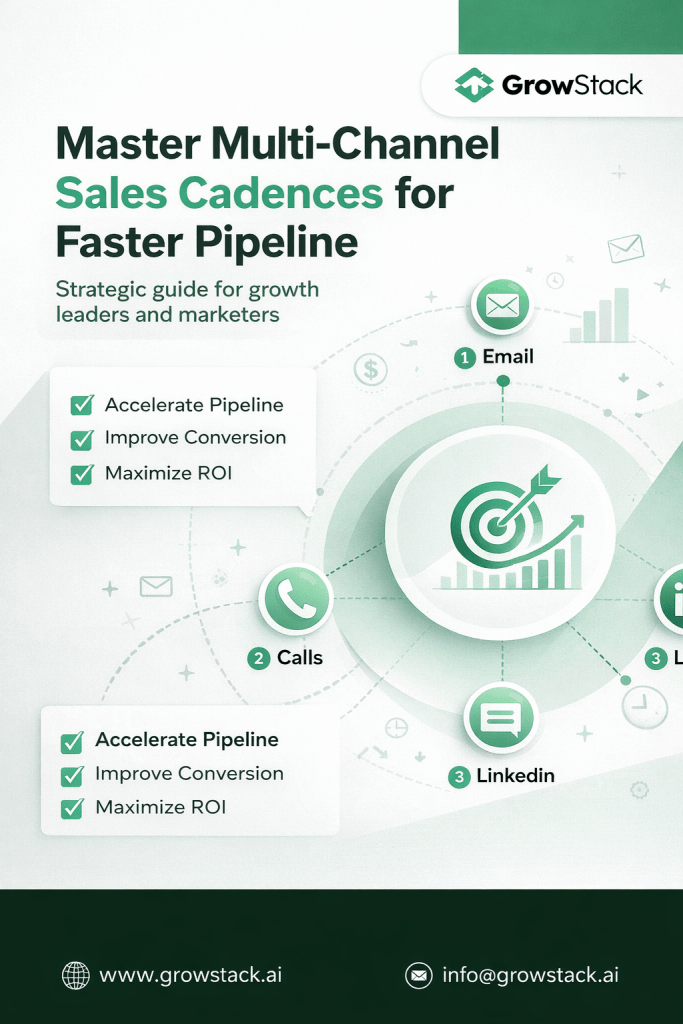
Sales Cadences: Building Revenue Momentum With Multi-Channel Workflows
Master multi-channel sales cadences to accelerate pipeline velocity, improve conversion rates, and maximize ROI on outbound efforts. Strategic guide for growth leaders and marketers.
Opening
A sales cadence is a structured sequence of touchpoints—emails, calls, messages, and meetings—delivered across multiple channels over a defined period to move a prospect toward a buying decision. For marketing and growth leaders, it’s the operational backbone that transforms lead lists into qualified pipeline and pipeline into closed revenue.
The difference between teams that hit quota and those that don’t often comes down to cadence discipline. Without a clear, repeatable cadence, outbound efforts become reactive, inconsistent, and expensive. With one, you create predictable conversion paths, reduce sales cycle length, and give your team a playbook they can execute at scale.
What Is a Sales Cadence and Why Does It Matter for Revenue Teams?
A sales cadence is a repeatable sequence of outreach activities designed to engage a prospect at the right time, through the right channel, with the right message. It’s not a one-off email or a single phone call—it’s a coordinated campaign that spans days or weeks and uses multiple communication methods to break through noise and build momentum.
For growth leaders and founders, cadences matter because they directly impact three metrics that drive business outcomes: conversion rate, sales cycle length, and cost per acquisition. A well-designed cadence increases the probability that a prospect responds, reduces the time it takes to move them through your pipeline, and ensures your sales team spends time on high-intent prospects rather than chasing cold leads indefinitely.
In competitive markets, prospects are overwhelmed with inbound noise. A structured cadence cuts through that noise by being persistent without being annoying, strategic without being manipulative, and timely without being random.
Why Do Sales Cadences Improve Conversion Rates?
Conversion happens through repetition and relevance, not single touches. Research on buyer behavior shows that most prospects need multiple exposures to your message before they’re ready to engage. A cadence ensures those exposures happen in a logical sequence, building familiarity and trust over time.
When you space touchpoints strategically—mixing email, phone, LinkedIn, and other channels—you increase the likelihood that your message lands when the prospect is actually thinking about your problem. You also reduce the risk of being ignored or marked as spam, because each touchpoint serves a different purpose and feels intentional rather than automated.
For example, a demand generation team might start with a personalized email that references a specific company challenge, follow up with a LinkedIn connection request three days later, add a phone call on day seven, and then send a value-add piece of content on day ten. Each touchpoint is different, but they’re all part of one coherent narrative. Prospects who might ignore a single email often respond to the third or fourth touchpoint, especially when it comes from a different channel.
How Many Touchpoints Should Be in a Sales Cadence?
The optimal number of touchpoints depends on your sales cycle length, deal size, and prospect engagement level, but most high-performing teams use between 8 and 15 touchpoints spread over 4 to 8 weeks. Fewer than 5 touchpoints and you’re leaving money on the table; more than 20 and you risk damaging your brand reputation and getting flagged as spam.
The key is not the total number of touches, but the quality and spacing of each one. A cadence with 10 highly relevant, well-timed touchpoints will outperform a cadence with 20 generic ones. Each touchpoint should have a clear purpose: to introduce yourself, to provide value, to create urgency, to address objections, or to move toward a commitment.
A typical enterprise sales cadence might look like: email one (introduction), email two (value prop), phone call one (if no response), LinkedIn message, email three (social proof), phone call two, email four (case study or content), and then a final email offering a specific next step. For mid-market or SMB sales, you might compress this into 6 to 8 touches over 3 to 4 weeks.
What Channels Should You Use in a Multi-Channel Cadence?
The most effective cadences use at least three channels: email, phone, and LinkedIn. Email is scalable and allows for detailed messaging; phone is personal and allows for real-time objection handling; LinkedIn is social proof and allows for relationship building. Together, they create multiple pathways for a prospect to engage.
Email should be your primary channel because it’s scalable and creates a written record. Phone should be your secondary channel because it’s high-touch and allows for conversation. LinkedIn should be your tertiary channel because it’s less intrusive than email and phone, but still visible and professional.
Some teams also add SMS, video, or direct mail for high-value prospects, but these should be used strategically and only when you have strong data quality and clear permission. The goal is to be present across channels without being omnipresent or annoying.
A practical example: an SDR team targeting enterprise accounts might send an email on Monday, make a phone call on Wednesday, send a LinkedIn message on Friday, send another email on Monday of the following week, and then make a second phone call on Wednesday. This creates a rhythm that feels intentional and gives the prospect multiple ways to respond.
Why Does Timing Matter in Sales Cadences?
Timing affects open rates, response rates, and conversion rates. Emails sent on Tuesday through Thursday typically have higher open rates than those sent on Monday or Friday. Calls made between 10 AM and 11 AM or 2 PM and 3 PM typically have higher connection rates than early morning or late afternoon calls. LinkedIn messages sent during business hours typically get faster responses than those sent outside working hours.
But timing also refers to the spacing between touchpoints. If you send two emails within 24 hours, the second one feels like spam. If you wait two weeks between touches, the prospect forgets who you are. The sweet spot is usually 2 to 4 days between touches, with variation based on the channel and the prospect’s engagement level.
Timing also depends on the prospect’s buying cycle. If you’re selling to a company that’s actively evaluating solutions, you can compress your cadence and be more aggressive. If you’re selling to a company that’s not yet in market, you need to be more patient and focus on building awareness and trust.
A growth team targeting mid-market companies might send an initial email on Tuesday morning, follow up with a phone call on Thursday afternoon, send a LinkedIn message on Monday, and then send a second email on Wednesday. This creates natural spacing and increases the chance that at least one touchpoint lands when the prospect is thinking about your problem.
How Should You Personalize Sales Cadences at Scale?
Personalization at scale means using data to customize the message and timing for each prospect, without requiring manual work for every single person. This is where most teams struggle: they want to personalize, but they don’t have the time or resources to write custom emails for hundreds of prospects.
The solution is to use data-driven segmentation and templating. Segment your prospect list by company size, industry, role, or buying signal. Create different cadence templates for each segment. Within each template, use dynamic fields to insert the prospect’s name, company, or specific challenge. This gives you the efficiency of templates with the relevance of personalization.
For example, instead of writing one generic email to all prospects, write three versions: one for enterprise companies, one for mid-market companies, and one for SMBs. Within each version, use dynamic fields to insert the prospect’s company name and a specific challenge relevant to their industry. This takes a few hours to set up, but then scales to thousands of prospects.
The highest-performing teams also use engagement data to personalize the cadence itself. If a prospect opens your first email but doesn’t click, you might send a different second email that addresses common objections. If a prospect clicks but doesn’t respond, you might send a third email with a case study or social proof. This requires more sophistication, but it dramatically improves conversion rates.
What Role Does Data Quality Play in Cadence Success?
Bad data kills cadences. If your email list is full of invalid addresses, your open rates will be low and your bounce rates will be high. If your phone numbers are outdated, your connection rates will be low. If your prospect information is inaccurate, your personalization will feel generic or irrelevant.
Data quality directly impacts ROI. A cadence with 80% accurate contact data will generate 3 to 5 times more pipeline than a cadence with 50% accurate data, even if the messaging is identical. This is why leading teams invest in data verification and enrichment before launching outbound campaigns.
Before launching a cadence, audit your data for completeness, accuracy, and relevance. Verify email addresses and phone numbers. Enrich prospect records with company information, job titles, and buying signals. Remove duplicates and invalid records. This upfront work takes time, but it saves time and money downstream by reducing wasted touches and improving conversion rates.
A demand generation team targeting 1,000 prospects might spend a week cleaning and enriching their data, which reduces their list to 850 valid prospects. But those 850 prospects will generate 2 to 3 times more pipeline than the original 1,000, because each touch is reaching a real person with accurate information.
How Do You Measure Cadence Performance?
Cadence performance is measured through engagement metrics and conversion metrics. Engagement metrics include open rate, click rate, reply rate, and connection rate. Conversion metrics include meeting booked rate, qualified opportunity rate, and pipeline generated.
The most important metric is reply rate, because a reply indicates genuine interest. A cadence with a 5% reply rate is performing well; a cadence with a 10% reply rate is performing exceptionally well. Reply rate is more important than open rate, because an open doesn’t mean the prospect is interested, but a reply does.
The second most important metric is meeting booked rate, because a meeting is a concrete outcome that moves the prospect forward. A cadence that generates a 1% meeting booked rate from initial outreach is performing well; a cadence that generates a 2% meeting booked rate is performing exceptionally well.
Track these metrics by cadence, by segment, by channel, and by SDR or team member. This allows you to identify which cadences are working, which segments are most responsive, which channels are most effective, and which team members are most skilled. Use this data to optimize your cadences and allocate your resources more effectively.
Why Do Some Prospects Respond to Cadences and Others Don’t?
Response depends on three factors: relevance, timing, and trust. If your message isn’t relevant to the prospect’s current challenge or priority, they won’t respond, no matter how many times you reach out. If your timing is off—you’re reaching out when they’re not thinking about your problem—they won’t respond. If they don’t trust you or your company, they won’t respond.
Relevance is the most important factor. Before you launch a cadence, make sure you understand the prospect’s business, their likely challenges, and why your solution matters to them. Use this understanding to craft a message that speaks directly to their situation, not a generic message that could apply to anyone.
Timing is the second most important factor. Some prospects are actively evaluating solutions and will respond quickly. Others are not yet in market and will ignore your outreach. Your cadence should account for this by being more aggressive with high-intent prospects and more patient with low-intent prospects.
Trust is the third most important factor. If the prospect has never heard of your company, they’re less likely to respond. If they’ve had a bad experience with your company or your industry, they’re less likely to respond. Build trust by being helpful, by being honest about what you can and can’t do, and by respecting their time and preferences.
How Should You Handle Objections in a Sales Cadence?
Objections are a normal part of the sales process, and a well-designed cadence anticipates and addresses the most common ones. The most common objections are: “I’m not interested,” “I don’t have time,” “We’re not in market,” “We’re already using a competitor,” and “Your price is too high.”
Rather than waiting for a prospect to voice an objection, address it proactively in your cadence. If you know that many prospects will say “We’re already using a competitor,” include a message in your cadence that acknowledges this and explains why your solution is different or better. If you know that many prospects will say “I don’t have time,” include a message that respects their time and offers a very specific, low-friction next step.
The key is to address objections with empathy and evidence, not with defensiveness or aggression. Acknowledge the objection, explain why it’s a common concern, and provide a specific reason why it shouldn’t prevent them from having a conversation with you.
For example, if a prospect says “We’re already using a competitor,” you might respond: “I understand—most companies in your space are. That said, we’ve helped companies like [similar company] reduce their costs by 30% while improving their results. Would it make sense to spend 15 minutes exploring whether we could do the same for you?” This acknowledges the objection, provides social proof, and offers a specific, low-friction next step.
What’s the Difference Between a Sales Cadence and a Nurture Campaign?
A sales cadence is an active outreach sequence designed to engage a prospect who has been identified as a potential fit for your solution. A nurture campaign is a passive content sequence designed to keep a prospect engaged over a longer period, even if they’re not yet ready to buy.
Sales cadences are typically shorter (4 to 8 weeks), more aggressive (multiple touches per week), and more personalized (tailored to the specific prospect). Nurture campaigns are typically longer (months or years), less aggressive (one touch per week or less), and more generic (the same content sent to many prospects).
Sales cadences are appropriate for prospects who have been identified through research, referral, or inbound inquiry. Nurture campaigns are appropriate for prospects who have engaged with your content but aren’t yet ready to buy, or for prospects who have been disqualified but might be a fit in the future.
Many teams use both: a sales cadence to actively pursue high-intent prospects, and a nurture campaign to stay in touch with lower-intent prospects. This allows you to be aggressive with prospects who are ready to buy, while still maintaining relationships with prospects who might be ready in the future.
How Do You Build an SDR Playbook Around Sales Cadences?
An SDR playbook is a documented set of processes, templates, and guidelines that your SDR team uses to execute sales cadences consistently and effectively. A good playbook includes: cadence templates for different segments, email templates for different stages, phone scripts for different scenarios, and guidelines for when to move a prospect to the next stage or disqualify them.
The playbook should be specific enough to guide new SDRs, but flexible enough to allow experienced SDRs to adapt based on the prospect’s engagement. It should include examples of good and bad outreach, so SDRs understand what success looks like. It should be updated regularly based on what’s working and what’s not.
A practical playbook might include: a cadence template for enterprise prospects (15 touches over 8 weeks), a cadence template for mid-market prospects (10 touches over 6 weeks), email templates for each stage of the cadence, phone scripts for initial outreach and follow-up calls, and guidelines for when to move a prospect to sales or disqualify them.
The playbook should also include metrics and targets: “We expect a 5% reply rate from this cadence, a 1% meeting booked rate, and a 20% qualified opportunity rate.” This gives SDRs a clear target to aim for and allows you to identify which SDRs are performing above or below expectations.
How Do You Avoid Being Marked as Spam or Annoying Prospects?
The line between persistent and annoying is thin, and crossing it damages your brand reputation and reduces your conversion rates. To stay on the right side of that line, follow these principles: be relevant, be respectful, be honest, and be helpful.
Be relevant by making sure your message speaks to the prospect’s actual business and challenges, not a generic pitch. Be respectful by respecting their time, their preferences, and their inbox. Be honest by being clear about who you are and what you want. Be helpful by providing value in every touchpoint, not just asking for a meeting.
Also, make it easy for prospects to opt out. Include an unsubscribe link in every email. If a prospect asks to be removed, remove them immediately. If a prospect says they’re not interested, respect that and don’t continue the cadence. This protects your reputation and ensures that the prospects who do engage with you are genuinely interested.
Monitor your bounce rate, unsubscribe rate, and spam complaint rate. If any of these are high, it’s a sign that your data quality is poor, your messaging is off-target, or your cadence is too aggressive. Adjust accordingly.
What Tools and Platforms Support Sales Cadence Execution?
Sales cadence execution requires tools that can manage contacts, schedule outreach, track engagement, and measure results. The most common tools are CRM platforms (Salesforce, HubSpot, Pipedrive), sales engagement platforms (Outreach, Salesloft, Apollo), and email marketing platforms (Mailchimp, Klaviyo, ConvertKit).
For most teams, a CRM platform is the foundation. It stores prospect information, tracks interactions, and provides visibility into the pipeline. A sales engagement platform adds automation and intelligence on top of the CRM, allowing you to schedule cadences, track engagement, and optimize based on data.
The specific tool you choose depends on your team size, your budget, and your technical sophistication. A small team might use a CRM and a spreadsheet. A mid-size team might use a CRM and a sales engagement platform. A large team might use a CRM, a sales engagement platform, and a data enrichment platform.
The most important thing is not the tool, but the discipline to use it consistently. A team with a simple tool and strong discipline will outperform a team with a sophisticated tool and weak discipline.
How Do You Optimize Cadences Based on Performance Data?
Optimization is an ongoing process. Launch a cadence, measure its performance, identify what’s working and what’s not, and then adjust. The most common optimizations are: changing the message, changing the timing, changing the channel mix, or changing the target segment.
If your reply rate is low, the problem is likely your message. Test different subject lines, different opening lines, or different value propositions. If your meeting booked rate is low, the problem might be your phone script or your qualification criteria. If your overall conversion rate is low, the problem might be your target segment or your data quality.
Use A/B testing to validate your hypotheses. Test one variable at a time (subject line, opening line, call time, etc.) and measure the impact on your key metrics. Once you’ve identified a winner, make it your new baseline and test the next variable.
Document your learnings and share them with your team. If you discover that emails sent on Tuesday have a 20% higher open rate than emails sent on Monday, change your cadence to send on Tuesday. If you discover that a specific opening line generates a 10% higher reply rate, use that opening line in all your cadences.
FAQ
What’s the minimum number of touches needed to see results from a sales cadence?
Most teams see meaningful results with 5 to 8 touches spread over 3 to 4 weeks. However, the quality of each touch matters more than the quantity. A cadence with 5 highly relevant, well-timed touches will outperform a cadence with 15 generic ones. The key is to space touches strategically, use multiple channels, and ensure each touch has a clear purpose. Start with 8 touches and adjust based on your response rates and conversion metrics.
How long should I wait before disqualifying a prospect from a cadence?
Disqualify a prospect after you’ve completed your full cadence and received no response, or after they’ve explicitly said they’re not interested. Don’t disqualify based on a single non-response; many prospects need multiple touches before they engage. However, if a prospect explicitly says “not interested” or “remove me,” respect that and disqualify them immediately. For most cadences, this means waiting 4 to 8 weeks before disqualifying. If you’re selling a longer sales cycle product, you might wait longer.
Should I personalize every email in a cadence, or just the first one?
Personalize the first email heavily, because it determines whether the prospect opens your second email. Personalize subsequent emails based on the prospect’s engagement level. If they’ve opened your first email but not clicked, send a different second email that addresses common objections. If they’ve clicked but not replied, send a third email with social proof or a case study. This requires more sophistication, but it dramatically improves conversion rates. At minimum, always include the prospect’s name and company in every email.
What should I do if a prospect engages but then goes silent?
If a prospect engages (opens, clicks, or replies) but then goes silent, it usually means they’re interested but not yet ready to buy. Continue the cadence, but adjust your messaging to focus on building trust and providing value, rather than pushing for a meeting. You might send a case study, an industry report, or a customer testimonial. If they continue to engage but don’t move forward, consider moving them to a nurture campaign and focusing your active outreach on higher-intent prospects.
How do I know if my cadence is too aggressive?
Your cadence is too aggressive if your unsubscribe rate is above 0.5%, your spam complaint rate is above 0.1%, or your bounce rate is above 5%. It’s also too aggressive if prospects are explicitly telling you to stop contacting them. If you see these signs, reduce the frequency of your touches, increase the time between touches, or reduce the total number of touches. You can also improve your data quality and personalization, which often reduces the perception of aggression.
Should I use the same cadence for all prospects, or customize by segment?
Customize by segment. Prospects in different industries, company sizes, or roles have different needs, different buying cycles, and different communication preferences. A cadence for enterprise prospects should be longer and more formal than a cadence for SMB prospects. A cadence for a technical buyer should focus on features and ROI, while a cadence for an executive should focus on business impact and strategic value. Create 3 to 5 cadence templates for your most important segments, and use the same template for all prospects within each segment.
How do I balance outbound cadences with inbound marketing?
Outbound cadences and inbound marketing serve different purposes and should work together. Inbound marketing builds awareness and generates leads; outbound cadences convert those leads into meetings and opportunities. Use inbound marketing to build a pipeline of prospects, and use outbound cadences to accelerate the conversion of those prospects. Also, use inbound marketing to build credibility and trust, which makes your outbound cadences more effective. A prospect who has read your blog post or downloaded your whitepaper is more likely to respond to your outbound email.
What’s the best way to handle a prospect who says they’re not in market?
If a prospect says they’re not in market, don’t disqualify them immediately. Instead, move them to a nurture campaign and stay in touch over a longer period. Many prospects who say they’re not in market today will be in market in 6 to 12 months. By staying in touch, you ensure that when they do enter the market, they think of you first. You might send them a monthly newsletter, a quarterly industry report, or an annual check-in. This keeps your company top-of-mind without being aggressive or annoying.
How do I measure the ROI of my sales cadences?
Measure ROI by comparing the revenue generated from cadence-sourced opportunities to the cost of running the cadence. The cost includes salaries, tools, and data. For example, if your cadence generates 10 qualified opportunities with an average deal size of $50,000 and a 30% close rate, that’s $150,000 in revenue. If the cost of running the cadence is $20,000, your ROI is 7.5x. Track this metric by cadence, by segment, and by team member. Use it to identify which cadences are most effective and where to invest more resources.
citations:
- [1] https://commercev3.com/maximize-rankings-with-long-form-content-seo/
- [2] https://bird.marketing/blog/digital-marketing/guide/content-marketing/long-form-content-benefits-best-practices/
- [3] https://www.stellarcontent.com/blog/seo/is-long-form-content-the-way-to-go/
- [4] https://slateteams.com/blog/long-form-content
- [5] https://searchengineland.com/guide/longform-content
- [6] https://scottleroymarketing.com/the-rise-of-long-form-content-a-deep-dive-into-its-impact-on-seo-and-audience-engagement/
- [7] https://www.seoptimer.com/blog/long-form-content/
- [8] https://www.logicalposition.com/blog/how-to-boost-seo-and-engage-users-with-long-form-content
 Growsatck.ai
Leave a comment